It is not news, by now, that our economy is in serious trouble. Most of us worry about our household budgets, our savings, our retirement plans. It is nearly impossible to turn on the television, listen to the radio, or pick up a newspaper without encountering the dire reports of further decline in our economic picture. And it isn't just us here in the U.S. -- around the world, the chaos is spreading, causing reverberations around the globe.
We debate the pros and cons of bailouts -- for the financial industry, for the automobile industry, for who knows who else might be next with their hats out... There is however, one sector of our economy that impacts each and every one of us in our daily lives: Managing our schools, caring for our elderly and our disabled, supporting the ability of young people to attend college, maintaining the safety of our cities and towns, providing for the maintenance and care of our roads, parks, and forests, inspecting and protecting our food supplies. Our state governments provide us with services and supports across a broad spectrum of social concerns. As our economy has fallen into turmoil, as jobs are lost, as revenues decline, our state level governments are feeling the pinch.
Here in Ohio, the situation is becoming dire, and our governor has asked state agencies to describe what cuts and service changes will result from a projected 25% state budget cut over the next budget cycle. What follows, here is the text of that document. I know that we've got readership all over the country, and perhaps some states are in better shape than we are here in the midwest, but I bet there are plenty of you who are living in places where the picture is nearly as bleak.
Our Governor Strickland is working with other state governors to ask the congress and the federal government for a $100 billion block grant to help states manage this revenue shortfall. Wherever you live, whatever your political persuasion, there are too many dreadful and draconian impacts from this kind of economic collapse for us to allow it to occur without some effort to find solutions. Take a look. Substitute the name of the place you live for "Ohio," and then call and write to your congressional leaders and tell them that aid to the states is an immediate and absolute priority.
Here are some talking points, and then the whole document follows (I apologize for the formatting issues with all of this, but please do take a look) swan--
What Ohio Needs in a Federal Recovery PackageAt flat funding for FY2010-11, Ohio is projected to have a $7.3 billion deficit. If each agency is funded at 90% for FY10-11,Ohio would still have a $4.7 billion deficit for the coming biennium. Additionally, Ohio is facing a $640 million deficit in theremaining portion of FY 2009.Many governors, including Ohio’s, must introduce their budgets in January and February 2009. Assistance is neededimmediately if we are to avoid budgeting for and beginning to execute even more painful reductions. While infrastructuremoney would be welcomed, states also need flexibility to continue providing the important services they currently provide.$100 Billion in Block Grants to the States• Unless federal resources are provided, the severe nature of current and future shortfalls states are facing could havedevastating consequences on core services states provide, including education (early care through higher education),healthcare, vaccinations, food safety, and other vital public health and safety net services. Additionally, if there werenot block grants, job creation programs at the state level would likely be cut, undermining any federal stimulus effort.• Giving states block grants to ensure that these services are not compromised and that states can continue to invest ineducation at all levels is a critical part of any recovery plan.An Increase in Federal Matching Assistance Percentage (FMAP) for Medicaid• During an economic downturn the number of people relying on Medicaid increases and Ohio‘s Medicaid roles willcontinue to grow.• Increasing the share the federal government pays for Medicaid will free up state general revenue fund (GRF) dollarscurrently being used for the Medicaid program. This would greatly assist the state’s efforts to provide and maintainaccess to healthcare services for vulnerable populations and free up GRF for other important services, includingeducation, and job creation activities.$ 3.2 Billion in Additional TANF Funds to the States• TANF allows states and counties to meet the basic needs of low income families.• Ohio will not have enough TANF resources to assist our neediest families in each of the coming years.• Because there are currently fewer jobs available, TANF work requirements should also be waived during this time ofrecession.• The state match to pull down these federal funds should be waived.Other Types of Assistance That Would Benefit the State of Ohio• A temporary increase in food stamp benefits. For many families, food stamp benefits typically run out after thesecond or third week of the month, causing more and more families to turn to increasingly burdened soup kitchensand food pantries.• Additional federal support for child support enforcement, reversing the federal cuts that were put in place in 2006.• Increased federal funding for child care, including an increase to the Child Care Development Block Grant and HeadStart.• Further investment in infrastructure, such as highways, water projects, public transit, rail, broadband and schools.
What Might It Mean If All Agencies Took a 25% Funding Cut?
Recent financial projections show that if appropriation levels for FY 2010 and
2011 were to remain flat, the State of Ohio would face a $7.3 billion deficit. If this
$7.3 billion deficit were to be addressed solely through cuts in agency budgets (and
for the purposes of this analysis, debt service, tax relief and Medicaid were not cut)
and every agency were to take the same percentage level cut, each agency would
take a 25% cut in agency funding levels.
Many have asked what a 25% cut might mean to the services that state government
currently funds. Agencies were asked to provide scenarios that describe the
program reductions which might be necessary if they had to operate with such cuts.
This compilation of materials, which the agencies quickly assembled, is only for
illustration purposes – it is not intended to in any way reflect recommendations of
the agencies or decisions about how the State will deal with the current projected
deficit.
The Ohio Department of Education
The Department of Education’s budget would have to be reduced by $2.0 billion in FY 2010.
These funding levels would be similar to funding in FY 2001. This does not account for income
tax relief.
A per-pupil reduction of all SF-3 funding for school districts and community schools would have
to be made totaling about $840 per pupil in FY 2010 and $870 per pupil in FY 2011. This
would undoubtedly force many schools into a deficit situation with their only option being
entering fiscal emergency and requesting solvency assistance funding from the state. It is
uncertain how much in solvency funds would be requested but demand could exceed solvency
assistance resources with a current cash balance of only $10.8 million. If all requests could not
be made districts may not be able to make payroll since about 85% of their budgets are made up
of payroll.
Joint vocational school districts provide career-technical programming to many high school
students, and are expected to receive state funding totaling about $250 million in FY 2009 so a
25% cut would result in only about $187.5 million available for FY 2010 and for FY 2011 to
fund basic aid, special education weighted funding, career-tech weighted funding, and guarantee
funding to joint vocation school districts. This will impact an unknown number of programs and
students – could see an elimination or reduction in general operations, including staffing.
MRDDs and institutions total $49.2 million in FY 2009 mostly for special education weighted
funding and a small portion for career-tech weighted funding in institutions. This funding would
be reduced by about $12.3 million in FY 2010 and flat funded in FY 2011. This could result in
2
an elimination or reduction in general operations, including staffing. In essence, county
MR/DD’s would have to pick up a greater share of the cost for providing these services or
possibly even see the elimination of services by county MR/DD’s, resulting in local districts
having to pick up the cost.
Bus purchase funding would be cut by $3.3 million, reducing the ability of districts to purchase
new buses and to update their fleets.
Additional reductions of 25% in FY 2010 and flat funding in FY 2011 would result in the
following:
• Alternative Education: Reduction of $2.9 million in FY 2010 and flat funding in FY
2011 would force many of these programs to close. These programs serve the most atrisk
population of kids and included grants to districts to serve this population. These
cuts could result in possible reductions or elimination of programs, with rural areas being
especially at risk.
• School improvement: Reduction of $3.3 million in FY 2010 and flat funding in FY 2011
would reduce school improvement efforts around the state. This would result in a
statewide reduction in funds for ESC’s. These funds are used to provide technical
assistance to the scools.
• GED: Reduction of $386,000 in FY 2010 and flat funding in FY 2011 could result in
students not being able to take their GED test to receive a high school diploma.
• Early Childhood: Reduction of $9.1 million in FY 2010 and flat funding in FY 2011
could eliminate services for these students. In FY 2008, 6100 kids were served by these
programs. Cutting these funds could potentially impact either the number of available
slots for public preschool AND/OR permit the same number of slots but less subsidy per
child.
• Preschool Special Education: Reduction of $20.8 million in FY 2010 and flat funding in
FY 2011 would be the equivalent of eliminating funding for 500 of the approximate
2,000 units currently being funded.
Ohio Board of Regents
1. The Base: At current FY 2009 funding levels, higher education would expect to receive
$2.83 billion in state support in the FY 2010 operating budget.
a. A cut of 25% on a $2.83 billion base equals $707 million.
2. Of the total $2.83 billion, approximately $364 million is provided for debt service, which
is a legal obligation, for which payment cannot be deferred or reduced.
3. Assuming that debt service is exempt from a cut, $2.47 billion would then become the
base against which $707 million in cuts would be applied.
a. Reduce state support per full-time student statewide by $1,987 (there are 356,000
full-time students are enrolled in the University System of Ohio);
i. This would reduce state support per student to its lowest level, in constant
dollars, in the recent history of the state;
b. Reduce Ohio State University’s state support by an estimated $119.6 million;
c. Reduce the University of Cincinnati’s state support by an estimated $55 million;
3
d. Reduce the state’s need-based aid programs by an estimated $70 million;
e. Reduce Ohio’s agricultural research programs by almost $12 million; and
f. Pare Ohio’s cooperative extension program by $8.4 million, etc.
4. Loss of funds of this magnitude could be addressed in one of two ways – with or without
offsetting fee increases.
a. In the absence of offsetting fee increases, a $707 million cut would result in:
i. A rapid depletion of campus fund balances;
ii. Massive layoffs of faculty and staff; and
iii. Closure of many academic instructional and research programs, and
perhaps even campuses.
b. Offsetting fee increases would have the following impact:
i. Student tuition and fees would have to increase, on average, almost
$2,000.
ii. An increase of this magnitude would cause:
1. Tens of thousands of students to drop out of college;
2. Thousands of others to switch from full-time to part-time status,
and
3. Others to increase their student debt burden significantly.
Ohio Department of Job and Family Services and Early Childhood
With limited staff at the local level, the wait for food stamps and child care services will likely
exceed reasonable limits leaving people waiting for services when the need is immediate.
ODJFS provides hundreds of millions of dollars for services administered at the local level.
There would be a severe reduction in non-federal share (state dollars) that would likely stretch
resources at local JFS office forcing counties to consider or begin workforce reductions.
When receiving cash benefits, the federal government requires those individuals to seek
employment or they risk losing benefits. Due to the difficulty some encounter finding work in a
marketplace with a 6.8% unemployment rate, some job seekers are less likely to secure long term
employment. This unique scenario places Ohio workers at risk of losing benefits and places the
state at risk for significant federal workforce penalties unless the rules are relaxed immediately.
Early Childhood Services
Early care and education is CRITICAL to Ohioans being able to work.
The reduction of the availability of child care assistance will affect Ohioans ability to work or
cause them to make choices that jeopardize the health and safety of their children.
• Based on the assumption that there is a reduction in TANF funding, early care and
education (child care and the early learning initiative) will receive a $300,000,000 cut for
SFY 10 and SFY 11. Approximately 56,000 children, a 40% reduction, will not have
access to early care and education services.
4
• Assuming a 25% reduction to GRF funds for early care and education services (child care
and early childhood education), an additional $30,000,000 will not be available to
support another 5,600 children. This means that in the course of the year Ohio will go
from supporting 119,000 children with early care and education services to 57,400.
Home visiting:
• Based on the assumption that Help Me Grow will not receive funding through TANF
($54 million) and with a 25% cut to the GRF for this program, Ohio will be forced to end
our newborn home visits to all first time and teen parents and nearly eliminate our home
visiting programs for families with children “at-risk” of developing a delay or disability.
In SFY08, 34,597 newborn visits occurred.
In SFY08, 35,787 families received on-going home visiting and parent education.
• In SFY10 and 11 without TANF and a 25% cut to GRF, we would only be able to
provide on-going home visiting and parent education to approximately 4,000 families.
Ohio Department of Aging
Impact of a 25% Reduction in State Funding to Aging Services
PASSPORT -
Enrollment in PASSPORT, Ohio’s home and community based services alternative to nursing
facility placement, would be restricted.
In FY 2010, about 6,480 people would not be served who would otherwise be served at full
funding. In FY 2011, an additional 6,800 would not be served. Most of these people would not
wait for service. Additionally, the average wait-time would quickly become greater than 5
months. In FY 2011, the average wait time would be more than 7 months. They would have no
choice other than to move to a nursing facility, at a cost to the state that is three times that of
PASSPORT because nursing facility care is a federal mandatory Medicaid service.
FY 2009 FY 2010 FY 2011
Monthly New Enrollment 830 330 350
Average Monthly Caseload 28,547 28,815 23,370
Total Unduplicated Served (Slots) 37,770 33,160 29,200
End of Year Waiting for Service -0- 2,500 2,800
Assisted Living –
GRF Funding for Assisted Living would be about $7.5 million each year, down from the current
$9.5 million for FY 2009.
No new people would be served. Significant overspending would result from trying to serve the
existing caseload. ($3 million in FY 2010 and $1 million in FY 2011.) Individuals eligible for
assisted living will either remain in nursing facilities (half of all current assisted living
5
enrollments are nursing facility residents) or will have no choice for care other than a nursing
facility.
PACE
Ohio’s Program of All-Inclusive Care for the Elderly (PACE) is a capitated program that
provides primary, acute, and long-term care for a nursing facility eligible population. No new
PACE sites could be established in Ohio.
GRF funding would be reduced from $9.7 million currently in FY 2009 to about $7.7 million.
We wouldn’t be able to enroll anyone in the two existing PACE sites in FY 2010. The caseload
would have to be reduced from about 690 people at the end of FY 2009 to about 425 by the end
of FY 2010, or about 265 people. This disenrollment would likely be greater than the normal rate
(attrition).
In FY 2011, we would be able to enroll just under 20 people each month, gradually building the
caseload back to about 640 people at the end of FY 2011.
Senior Community Services and Alzheimer’s Respite
Ohio will not meet its federal maintenance of effort requirements to receive Ohio’s allotment of
funds under the Older Americans Act. Leaving federal money (as much as $45 million) “on the
table” will force service cutbacks at senior centers and other local providers for key services such
as congregate and home-delivered meals, transportation, in-home services, adult day services and
many others.
This could put the Department of Aging at risk to lose the whole Older Americans Act grant,
resulting in the department being unable to serve 200,000 older adults.
Residential State Supplement
Caseload would have to decline from the current 1,900 to about 1,500 at the end of FY 2010 and
about 1,400 at the end of FY 2011. The rate of decline is faster than normal attrition. No new
enrollment could be accepted for the program until the last few months of the biennium.
Internal Costs
The Ohio Department of Aging will be forced to manage a reduction of 25% in operating costs.
This would mean reducing the department staff by 10%.
Ohio Department of Mental Health
At the Department of Mental Health, the offices of Children’s Services and Prevention, Forensic
Services and Residency Programs would be closed, eliminating these programs. Other divisions
will be impacted with significant reductions.
Community linkage staff will be eliminated from eleven prisons; this would make the re-entry
process more difficult for those leaving prisons and could result in individuals leaving prison
without being linked to appropriate community mental health providers.
6
Services for the uninsured would be eliminated in Ohio counties that have no local funding.
Brown, Gallia, Jackson, Meigs, Adams, Scioto, Lawrence and Medina Counties would have no
state or local funding; there would be no publically funded mental health services in these
counties, most of which are Appalachian counties. In counties with local funding, community
mental health services would be severely restricted.
Housing options for consumers with severe and persistent mental illness (SPMI) would be
severely restricted and/or eliminated in most parts of the state. This would likely lead to an
increase in the homeless population.
ODMH would be forced to close an additional hospital and/or alter the operational structure of
one hospital. This is in addition to the closures of the Appalachian Behavioral Health Cambridge
campus and the Twin Valley Behavioral Health Dayton Campus in June 2008.
Nursing home placements of individuals with SPMI would grow, resulting in an increased
demand on this system.
There would be increased pressures on ODMH psychiatric hospitals regarding admissions and
greater lengths of stay due to greatly diminished local resources.
Ohio Department of Alcohol and Drug Addiction Services
• A 25% cut to GRF will also likely result in an additional reduction of federal funds
during the biennium due to the required State Maintenance Of Effort. The impact listed
includes the impact of both GRF and our federal block grant potential reductions.
• Our system is based on a partnership with county ADAS and ADAMH boards who plan
at the local level and providers who deliver direct services to our consumers. This level
of reduction will significantly impact the viability of our already financially strained
provider system of care.
• An across the board 25% cut will eliminate alcohol and drug treatment services to over
10,000 consumers (10% of those served in SFY 2007). The inability to provide these
services will be realized through increased costs within other systems such as the child
welfare, healthcare and the criminal justice system, in addition to lost wages and
productivity.
• A 25% across the board cut to Prevention services would significantly impact services to
school aged youth, college students, community based prevention initiatives, and
community coalitions, This would result in a reduction of over 15,000 youth, college
students and community residents not receiving prevention services based on our number
served during SFY .
• Drug Courts, TASC and similar linkage services provide an essential role in providing
treatment opportunities, ensuring support and transition to the criminal justice population
7
to reduce recidivism. This reduction would impact approximately 3,500 individuals who
would no longer be served through these programs.
• In addition, our outreach services and HIV programs will be significantly impacted by an
across the board cut and would reduce prevention education services to over 10,000
consumers who will not receive services, ultimately presenting the potential for increase
in HIV/AIDS and sexually transmitted diseases.
• The Federal SAMSHA Block Grant accounts for approximately 38% of our annual
budget of $188 million. All states are required to comply with the “Maintenance of
Effort” which requires our department to maintain a two year aggregate of state
expenditures. This reduction can result in an ADDITIONAL loss of $15 million dollars
which will impact critical services to Ohioans.
Ohio Department of MRDD
ODMRDD IMPACT ANALYSIS: FY10 appropriation at 75% of FY2009
Such a scenario would have serious and immediate impacts, which would be very difficult for
individuals, families, communities, providers, and local and state agencies responsible for the
MRDD service delivery system.
ODMRDD has made no decisions and is working with partners and stakeholders collaboratively
as the system confronts the unprecedented budget environment.
While other effects would likely emerge as the MRDD Community works through this very
challenging here are SOME major impacts:
• We would be forced to consider reducing waiver expenditures by 10 percent. This would
affect up to 18,000 individuals and families, the providers that serve them, and the county
and state staff that administer their individual service plans. We have already stemmed
the historical, and some would argue, expected annual growth in the average costs of
waivers. Currently we don’t have mechanisms in place to implement reductions of this
magnitude.
• Reductions of this magnitude could threaten the State of Ohio’s ability to maintain
compliance with the Martin Settlement Agreement. It appears that funding for 700
individuals yet to be enrolled would not be there. We are required by the lawsuit’s
settlement to enroll 1500 individuals by the end of this biennium.
• Currently, the State of Ohio supplements county board’s local tax revenues. For many
tax-poor urban and rural counties, ODMRDD adds to this subsidy support in an effort to
compensate for the variability in local tax revenues. Cutting county board subsidies by
this level would probably devastate most non-Medicaid programs operated by or funded
by these County Boards of MRDD. The following programs would be impacted, with
some jeopardized or eliminated altogether in many communities:
8
o Early Intervention
o Supportive Living
o Non-Medicaid Day Services
o Family Support Services (flexible funds to support families)
• We would be forced to consider reducing our Development Center capacity by half. Of
the 1,459 individuals being served in DCs as of December 1, 2008, 725 would need to be
placed on Medicaid home and community-based waivers and moved into the community.
This process would involve significant resources to manage and support, and would have
a serious economic impact on communities that rely on DCs as an employer and as a
service resource.
Ohio Department of Health
Reduction Summary Impact Statements
• Staffing reductions would be required across the majority of programs receiving GRF
funding.
• GRF reductions would result in a loss of federal dollars based on grant matching
guidelines.
• Programs such as Healthy Ohio, BCMH and Help Me Grow will be faced with either
reducing the service levels provided to clients or reducing the numbers of clients served.
• Staffing reductions in the Health Care Quality Assurance line item (440-453) would
result in the department no longer being able to perform the Federal Medicare/Medicaid
surveys in the state of Ohio. Therefore, the state of Ohio would be in violation of the
1864 Agreement with CMS, and this would have a direct impact on the Medicaid Budget
for the State of Ohio. Under the CMS Agreement between the State of Ohio and the
Secretary of Health and Human Services, the Governor will be obligated to inform the
Secretary that Ohio will not be able to meet contractual obligations relating to health care
surveys.
• Programs and activities such as Rabies baiting, and the inspection and licensure of
Manufactured Home Parks, Recreation Camps, and Marinas may be eliminated.
• Subsidy payments to Local Health Departments and other entities focused on health
promotion and prevention would be reduced. Reduced funding would lessen the
effectiveness of these programs on which many residents across Ohio depend.
• Vaccine and drug purchases would be reduced which would increase the health-risk
factors for Ohioans and may lead to increased health care costs.
The department will continue the process of aligning its available resources with the Governor’s
and department’s priorities.
9
The Ohio Department of Rehabilitation and Corrections
Impact on Funding
• Would require a reduction of GRF funding of $369,352,866 from FY09 funded level
(excluding Debt Service)
• Such a reduction would lead to a deficit of $386,996,368 in FY10 based on projected
continuation funded level (excluding Debt Service)
Impact on Staffing
• Would require the elimination of 5,237 positions, which includes security personnel
(corrections officers), parole officers, mental health professionals, education opportunities
and other programming team members.
Institutions
• Crowding: Would result in the closure of six institutions (310 staff each)
o Crowding increase from current level of 134% to 164% in FY10
o Triple-bunk inmates as a result of crowding
o Require substantial investment in infrastructure, such as sewage treatment
o Consider invoking Emergency Release Authority (ORC §2967.18)
• Mental Health: Potential non-compliance with the Dunn decree
o Mental health staff would have reduced interaction with non-severely mentally ill
offenders, limiting their ability to prevent crisis situations
• Medical: Potential non-compliance with the Fussell agreement
• Eliminate programming in:
o All unit management
o Most education
o Religious services
o Alcohol and other drug treatment
o Recreation
o Most farm operations
o Most Ohio Prison Industry
• Completely centralize all business and personnel offices
Department of Youth Services
_ Close 2 Large Facilities: 39.5m
_ Eliminate Private Fac. 2.7m
_ Eliminate Parole: 15.7m
_ 33% cuts RECLAIM, 510, CCF: 22.6m
_ 25% cut to central: 5.0m
TOTAL CUT: 85.6m
GRF funding at 75% of FY09 levels would necessitate the closing of 2 large juvenile
correctional facilities and 1 private facility. This is an approximately 30% reduction in bed
space. Additionally, eliminating one private facility would result in the loss of fifty beds.
10
There would be an elimination of all parole supervision and ancillary services (including case
management, residential placements, and wrap-around services). In CY 2008, the average
number of kids on parole as 1509. This would result in a significant number of kids without
parole supervision.
There would be a 33% cuts to subsidies to counties for community-based program alternatives
for youth who are adjudicated delinquent. This would result in significant community and
county layoffs. With fewer local options they would be forced to send more kids to DYS.
A 25% cut to the central office would result in the loss of 50 employees.
This would result in decreased public safety, exacerbated by the reduction of county options for
serving youth in the least restrictive setting and at the lowest cost. Lastly, DYS would
experience increased federal court involvement in the pending S.H. vs. Stickrath case.
Ohio Department of Development
1) Thomas Edison Program
A 25% reduction would equate to a reduction of about $4.2 million. This would involve the
closure of three or four Edison centers or Edison Incubators. The Edison Incubator program
houses about 350 early stage start up companies. A 25% reduction would result in reduced new
company formation of at least 8 companies, and potential closure of 3 Edison Incubators.
Employment growth as a result of Edison Center activities has average 2,900 per year. A 25%
reduction would result in a reduction of at least 750 jobs per year. Private investment from the
Edison Centers has been almost $700 million. A 25% reduction would result in a minimum of
$100 million.
2) The ODOD Rapid Outreach Program provides support for business expansion throughout the
state. A 25% reduction would equate to $2.5 million, reducing our ability to directly support at
least 10 Ohio businesses; reducing total capital investment that can be leveraged by those
companies by $452 million; and reducing our job creation and retention capacity (meaning we
would not be able to create 1,250 new jobs or retain 2,251 for about $58 million in payroll, based
on the proven records of our programs.) These reductions would inhibit ODOD's ability to be
flexible and responsive in response to business requests. These dollars are flexible and able to
meet business needs, leveraging private sector investment that would not have occurred other
wise
3) The Third Frontier Action fund provides support for research commercialization activities by
Ohio companies and Universities to translate research into products/services and Ohio jobs. A
25% reduction would equate to a reduction of $4.2 million, reducing support for at least 4
projects that would impact on 300 jobs, and reducing private investment by at least $17 million.
These reductions would limit the ability of Ohio to attract and nurture entrepreneurs and foster a
culture of innovation at our universities. This is an area where the number of projects increases
the possibilities of success.
11
4) Ohio's Workforce Guarantee provides support for businesses to train both incumbent workers
and new employees. A 25% reduction would equate to $3.2 million, resulting in 3,200 workers
in at least 63 companies not receiving training.
5) A continuation of the credit contraction would impact on the Department in the inability (or
inefficiency) of bond issuance for a full range of programs designed to support business growth
and investment.
Ohio Department of Natural Resources
The following would represent a 75% reduction request,
A. Parks GRF would drop to levels where there would need to be mothballing or closure of
strategic chosen facilities.
B. State Forests (smaller) would be transferred to DOW for operation and upkeep.
C. Division of Water would not be able to provide match for federal grant for Flood Plain
Management Program.
D. Soil and Water would not be able to provide match for first 6 months of the biennium.
E. Oil and Gas and Coal regulatory would not have enough operating budget for first 3
months of biennium
F. Soil and Water would have no match for districts. CREP program would be eliminated.
G. Oil and Gas will not have funds to meet regulatory obligation. Life health and safety.
H. Coal regulatory program would be effected (slower permit issues) and less
environmental controls.
I. Dam Safety minimum inspections would be able to be done. Move to 10 year inspection
cycle.
J. Parks would possibly need to merged with a dedicated funded division.
K. DNAP would be merged to another dedicated funded division.
Ohio Department of Agriculture
Food Safety Division
The ODA Food Safety Division works with local health departments to oversee the food safety
inspection of food processing, warehouses, and food retail establishments (except for restaurants,
which is administered by Ohio Department of Health). Currently, ODA has 14 inspectors. If
GRF were reduced by 25%, the agency would need to reduce that number by 3 – which would
mean that ODA would no longer be able to meet its commitments under two federal cooperative
agreements, thus losing another $170,000 or approximately another 3 staff members. Therefore,
our staff would be reduced from 14 to 8 people. This would have a devastating effect on the
division’s mission of ensuring wholesome and safe food. It is likely that the division would need
to eliminate the inspection of warehouses, farmers’ markets, home bakeries, and most
consultations to industry. Not only would this increase the risk of unwholesome food, it would
also affect many of the firms ability to stay in business.
12
Meat Inspection
The ODA Meat Inspection Division has the responsibility of inspecting all state licensed meat
processing plants and other facilities that process meat. Currently the Division inspects 203
facilities, with the vast majority being small, independently owned businesses. The Division
currently has approximately 86 inspectors. A 25% reduction in GRF (which would mean a
corresponding 25% reduction in the federal match) would result in the need to layoff 36 meat
inspectors, not fill 2 veterinary supervisor positions, not fill one agricultural manager position,
and layoff at least one enforcement agent. The impact of a lay off would result in the division
having to delay or deny services to the 76 establishments that harvest livestock and poultry.
Doing so would interfere with the normal flow of inspected and passed meat and poultry to the
marketplace. The meat and poultry industries, in particular smaller firms in smaller
communities, would suffer serious financial hardship. This reduction would also mean a reduced
capacity to monitor for foreign animal diseases and testing for certain food safety threats, such as
e coli.
Adjutant General’s Department
Impact of Hypothetical 25% GRF Cut in FY 2010-2011
• Total dollar reduction from previous budget guidance: $1,939,769
• Total reduction from 2009 funding: $3,232,949
• Air National Guard line must be protected:
o Every remaining dollar has a 3-1 federal match
o Minimum staffing levels are federal requirements (risk losing the air bases if state
support drops below minimum requirements).
• Bulk of cuts from Central and Army lines
o Those lines split personnel (60%), utilities (30%) and maintenance (10%)
o Cuts will zero-out maintenance funds (only the most critical, emergency repairs
will be performed).
o Closing facilities would have small impact on costs (Average annual utility cost
savings by closing a National Guard readiness center: $15,000). Those costs
would be offset by having to operate the remaining readiness centers on more
weekends to accommodate training requirements.
o Cuts would virtually eliminate 100% GRF positions (There are 94 pure GRF
positions in the ADJ budget, equaling about $5.1 million in 2009. Average
annual salary and benefits in the Army and Air lines is $56,000; to reach the 75%
level, 55 of 94 positions would need to be eliminated. Offsets for contracting for
services and unemployment costs to the agency would require additional cuts).
• Impacts on the Ohio National Guard:
o The most significant impact is that these cuts will severely strain our ability to
maintain the readiness of our forces and to respond in a timely manner when
needed. In addition to the virtual zeroing out of maintenance funding accounts,
the personnel cuts will impact custodial and maintenance workers and finance and
contracting personnel that are essential to maintenance operations.
13
o Facilities will deteriorate; recruiting and retention will be impacted; training will
be strained as units overcrowd remaining facilities.
o Risks federal force structure support. If the state cannot meet its obligations to
support the National Guard, the federal government may seek to reduce the size of
the National Guard in Ohio, putting at risk the $500 million ($250 million Army;
$250 million Air) in federal dollars that come to the state on an annual basis, and
reducing the capabilities available to the Governor for disaster response and other
needs.


12/13/2008
Toy Collection Report #4
I need to make some report on the session with the Law Paddle. It was this morning, and the pattern has been established -- write about it, get spanked with it, come back here and tell you all about it.
Except I've looked at my screen off and on all day, and I can't think what to say about it. If I tell you that it hurt, that probably won't be a huge surprise, or even news. That seems like a sort of "DUH" kind of statement.
He says I did fine. He says that my skin held up well. He told me that my butt looked wonderful afterwards -- hot and pink but not broken, bruised or welted. He loved it.
I don't think I can speak to the question asked earlier about whether lexan stings worse than wood. It is just different. I think today, I was more challenged by the power of the blows than I was by the material itself. I felt like He was hitting really hard. I felt like He was pounding into my bones. At some point, my mind flashed to the idea that maybe my pelvis might break -- and then He'd be sorry. Sigh... just like when I was a kid: "they'll be sorry when I'm dead..."
It is just silly. I know, logically, that He isn't going to do me physical harm. After all, I have padding over my pelvis -- as He was so quick to assure me. Blech.
Anyway, stand by for more bits and pieces of the toy collection -- we are nowhere near done with the paddle part of the collection. Got to get through all of those before I can turn to something easier...
swan
Except I've looked at my screen off and on all day, and I can't think what to say about it. If I tell you that it hurt, that probably won't be a huge surprise, or even news. That seems like a sort of "DUH" kind of statement.
He says I did fine. He says that my skin held up well. He told me that my butt looked wonderful afterwards -- hot and pink but not broken, bruised or welted. He loved it.
I don't think I can speak to the question asked earlier about whether lexan stings worse than wood. It is just different. I think today, I was more challenged by the power of the blows than I was by the material itself. I felt like He was hitting really hard. I felt like He was pounding into my bones. At some point, my mind flashed to the idea that maybe my pelvis might break -- and then He'd be sorry. Sigh... just like when I was a kid: "they'll be sorry when I'm dead..."
It is just silly. I know, logically, that He isn't going to do me physical harm. After all, I have padding over my pelvis -- as He was so quick to assure me. Blech.
Anyway, stand by for more bits and pieces of the toy collection -- we are nowhere near done with the paddle part of the collection. Got to get through all of those before I can turn to something easier...
swan
12/12/2008
Marriage? (updated / edited)
In our family, it is T who is the great fan and follower of DailyKos. It is linked here, and I check it, but I'm not nearly as consistent with that as is my "sister-heart." She pretty regularly forwards to Master and I whatever she finds interesting, enlightening, or particularly lucid from the conversations that happen there. I don't generally find that there is anything there that I need to bring here, to this Blog, but this one is different. So, here, for your enjoyment is a recent commentary made at the DailyKos on the subject of "Biblical Marriage:"
by kos Wed Dec 10, 2008 at 10:50:03 AM PST
jem6x has an excellent diary on Newsweek's great cover story on the Bible and gay marriage. Go check it out. But this comment by gladkov was particularly excellent. In short, if we are to let the Bible define what "traditional marriage" should look like, then our marriage laws should be amended as such:
A. Marriage in the United States shall consist of a union between one man and one or more women. (Gen 29:17-28; II Sam 3:2-5)
B. Marriage shall not impede a man's right to take concubines in addition to his wife or wives. (II Sam 5:13; I Kings 11:3; II Chron 11:21)
C. A marriage shall be considered valid only if the wife is a virgin. If the wife is not a virgin, she shall be executed. (Deut 22:13-21)
D. Marriage of a believer and a non-believer shall be forbidden. (Gen 24:3; Num 25:1-9; Ezra 9:12; Neh 10:30)
E. Since marriage is for life, neither this Constitution nor the constitution of any State, nor any state or federal law, shall be construed to permit divorce. (Deut 22:19; Mark 10:9)
F. If a married man dies without children, his brother shall marry the widow. If he refuses to marry his brother's widow or deliberately does not give her children, he shall pay a fine of one shoe and be otherwise punished in a manner to be determined by law. (Gen 38:6-10; Deut 25:5-10)
G. In lieu of marriage, if there are no acceptable men in your town, it is required that you get your dad drunk and have sex with him (even if he had previously offered you up as a sex toy to men young and old), tag-teaming with any sisters you may have. Of course, this rule applies only if you are female. (Gen 19:31-36)
Have I mentioned that I think this whole business of defining "marriage" based on religious beliefs and values is pure horse manure? I realize that people may have religious views on this topic, and they are surely welcome to them, but for those of us who may not share the same set of beliefs, why is it so difficult to make "marriage" a civil agreement between the parties for the sake of managing property and other family matters? For those who are interested, here is a link to an excellent piece that Master wrote a couple of years ago on The Myth of Modern Monogamy . He covers the topic in remarkable detail and depth.
In addition... a friend sent me this link privately. It is funny and provocative on the subject of what might be "interpreted" based on Biblical references...
swan
by kos Wed Dec 10, 2008 at 10:50:03 AM PST
jem6x has an excellent diary on Newsweek's great cover story on the Bible and gay marriage. Go check it out. But this comment by gladkov was particularly excellent. In short, if we are to let the Bible define what "traditional marriage" should look like, then our marriage laws should be amended as such:
A. Marriage in the United States shall consist of a union between one man and one or more women. (Gen 29:17-28; II Sam 3:2-5)
B. Marriage shall not impede a man's right to take concubines in addition to his wife or wives. (II Sam 5:13; I Kings 11:3; II Chron 11:21)
C. A marriage shall be considered valid only if the wife is a virgin. If the wife is not a virgin, she shall be executed. (Deut 22:13-21)
D. Marriage of a believer and a non-believer shall be forbidden. (Gen 24:3; Num 25:1-9; Ezra 9:12; Neh 10:30)
E. Since marriage is for life, neither this Constitution nor the constitution of any State, nor any state or federal law, shall be construed to permit divorce. (Deut 22:19; Mark 10:9)
F. If a married man dies without children, his brother shall marry the widow. If he refuses to marry his brother's widow or deliberately does not give her children, he shall pay a fine of one shoe and be otherwise punished in a manner to be determined by law. (Gen 38:6-10; Deut 25:5-10)
G. In lieu of marriage, if there are no acceptable men in your town, it is required that you get your dad drunk and have sex with him (even if he had previously offered you up as a sex toy to men young and old), tag-teaming with any sisters you may have. Of course, this rule applies only if you are female. (Gen 19:31-36)
Have I mentioned that I think this whole business of defining "marriage" based on religious beliefs and values is pure horse manure? I realize that people may have religious views on this topic, and they are surely welcome to them, but for those of us who may not share the same set of beliefs, why is it so difficult to make "marriage" a civil agreement between the parties for the sake of managing property and other family matters? For those who are interested, here is a link to an excellent piece that Master wrote a couple of years ago on The Myth of Modern Monogamy . He covers the topic in remarkable detail and depth.
In addition... a friend sent me this link privately. It is funny and provocative on the subject of what might be "interpreted" based on Biblical references...
swan
12/11/2008
Toy Collection #4
 These are law paddles, from Hanson Paddle Werks. They are part of the collection of Hanson Paddles that Master acquired in the years when John Hanson still owned and operated the company. These two are lexan. One is 1/4" thick and the other is 3/8" in thickness. Generally, with me, He uses the lighter of the two as it does much less severe damage to tissue. The heavier one is really heavy.
Some cursory research reveals that:
Lexan is a polycarbonate resin, used in molded products, as a substitute for glass, etc. Lexan is used in the aerospace industry for aircraft canopies, windscreens, and other windows, but can be found in household items, such as bottles, comact discs and DVDs. Perhaps the most visible Lexan consumer products are the Apple iBook and iPod. Their gleaming white plastic is Lexan. It also is used by Nalgene for their 1-liter wide mouth water bottle, popular with hikers and mountaineers. Lexan is also used by other water bottle manufacturers.
Lexan is also used in:
The visors for the helmets on the Apollo space programme
Automotive headlight covers to prevent small rocks and stones from breaking headlights bulbs
Racing cars to replace heavier (and breakable) glass windshields and windows
Greenhouses for covering
The Flexdex skateboards "Clear" models
Radio-controlled car bodies
Motorcycle goggles and Visors
Pseudo-brass knuckles
Radio-controlled helicopter fins and gyro mounts
Rubik's cube colored tiles
Air hockey pucks
Hockey rink glass
Nike ice hockey skates (specifically, the TUUK Lightspeed 2 blade holders)
Some guitar picks
An alternative for brass mouthpieces in brass musical instruments.
All New York City subway cars feature Lexan as a defense against vandalism
The jars for Blendtec blenders
Riot shields and the visors of Riot helmets
The visor in some fencing masks, and in many industrial safety shields and masks
Surfacing for features in terrain parks at ski and snowboard resorts
Disciplinary paddles and canes
Actually, there's a lot of information about Lexan, and I was a little bit surprised that "they" know that we use it to make paddles and canes... Hmmm.
But that isn't the place where I'm really interested in going with this rumination. As I've thought about these two paddles, what I find is that I am caught by the name: Law Paddle. I don't know why they are called "Law" paddles, and I really can't track down any explanation for that either. Maybe Master knows?
Maybe "Law" is the name of the person who came up with the basic shape for this ping-pong style paddle?
Maybe someone thought that you could use this type of paddle for "laying down the law?"
Maybe those are initials that stand for something like: Lexan And Wood?
I know that everytime I hear it I am reminded of a former student who's name sounded like "Law," but was spelled with an H instead of the W. I am completely convinced that that child would have benefitted from an encounter with a LAW paddle.
Perhaps, when it is all said and done, all that rambling around is about not really thinking too much about the paddle and ME. When I get too close to the pure reality of paddling with lexan, I have to embrace the intense density of the stuff. It is hard and it is cold and, while it is flexible to an extent, there is no real "give" to it. I think, as does He, that there is less damage with lexan. It seems to not bruise the way wood paddles of similar weight and size do. Still, it is intense.
The one other thing that is true of lexan paddles --and not of a wood paddle, is that I cannot console myself through a lexan paddling with visions of the darn thing merrily crackling away in our fireplace. The darn things are nearly indestructible... way more indestructible than I am.
swan
12/10/2008
Toy Collection Report #3
Jokari.
Sometimes with something odd sounding like that, I wonder if the word might actually mean something else... So I went and looked, and no... it really is just the name of the game, and for me, the name of a paddle. Except that, as paddles go, I have more trouble with this one than with most of the rest of them. For me, Jokari ought to mean "adversary," because it really does feel like my relationship with it is that of opponent or enemy.
When the Jokari paddle is "on the menu," my assumption is that it is all going to be horrible. I can't relax. I can't talk myself into any sort of calm place. The continual refrain in my head is: "nothing good is going to happen...nothing good is going to happen... nothing good could POSSIBLY happen!" And, of course, predictably -- nothing good (from my perspective) ever results from a Jokari paddling. Surprise!
So, the prescribed session with this paddle began on Saturday night. Late on Saturday night. We'd been at a meeting all day, and He'd been telling me that He was just dying to spank me... Unfortunately, on our way home, we got caught in a terrific traffic jam -- so the trip that would normally have taken us about an hour and a half lasted almost three hours. We were pretty well toasted when we got home. We managed to eat dinner. We sat together and watched some TV -- reruns of "House." Not a word was mentioned about any session through the whole evening. It wasn't until we got to our bedroom, well after 11PM, not until after I'd wandered around and done all the setting up chores -- that He pulled me to Him and began to spank me.
Piled face down over the side of the bed, hanging on to the blanket for some sort of anchor, I was surprised, and just not mentally ready for a full on assault with "the enemy." He has since told me that He really didn't use the paddle very intensely; that He was consciously trying to be careful with it. What I experienced, however, seemed hideously over the top, and as I fought to hang on to my blanket, I felt the fury boiling up inside of me. At some point it overflowed and I came roaring up, clenching my fists -- in an absolute rage. I didn't actually move from my position. The butt stayed put, but my frustration and anger was palpable.
I could hear the surprise in His voice when He talked me down. "What's going on? That didn't go very well. We'll finish this tomorrow. Come to bed, now." I crept into bed, burrowed into His chest, and tried to calm my breathing. I, of course, fussed all night.
The next morning, as we started up again, I knew how shaky I was, but I was determined to "be good." Even the very mildest implements, with which He started, burned into my flesh, and into my consciousness. I whimpered and shook and sobbed. None of the things that sometimes calm me were of any use. I was miserable in every cell of my being.
He stopped, after only a few minutes, and asked me what was wrong. I told Him I really didn't know -- that I just felt really mad, and that I didn't know why... He pulled me in, held me close, stroked me, and crooned silly, meaningless, Master noises at me. After a bit, when He asked me if I was really sure that I didn't know what was making me so angry, I heard myself sobbing about how it was December and that sticks me right back in front of the anniversary of the hysterectomy surgery, and I know that no one wants to hear how much I miss being OK sexually, and I really try not to dwell on it or talk about it, but I miss it... Or something like that -- all spilled out in a rush and a muddle.
I think that He did finally paddle me a bit with the lexan paddle and not the Jokari. I've spent the last few days believing that it was still looming out there somewhere -- the finish or completion, but last night He told me that it was time to move on to the next toy collection post. He even specified which toys should be part of the next piece.
So, I have survived the encounter with the enemy, at least for now.
swan
Sometimes with something odd sounding like that, I wonder if the word might actually mean something else... So I went and looked, and no... it really is just the name of the game, and for me, the name of a paddle. Except that, as paddles go, I have more trouble with this one than with most of the rest of them. For me, Jokari ought to mean "adversary," because it really does feel like my relationship with it is that of opponent or enemy.
When the Jokari paddle is "on the menu," my assumption is that it is all going to be horrible. I can't relax. I can't talk myself into any sort of calm place. The continual refrain in my head is: "nothing good is going to happen...nothing good is going to happen... nothing good could POSSIBLY happen!" And, of course, predictably -- nothing good (from my perspective) ever results from a Jokari paddling. Surprise!
So, the prescribed session with this paddle began on Saturday night. Late on Saturday night. We'd been at a meeting all day, and He'd been telling me that He was just dying to spank me... Unfortunately, on our way home, we got caught in a terrific traffic jam -- so the trip that would normally have taken us about an hour and a half lasted almost three hours. We were pretty well toasted when we got home. We managed to eat dinner. We sat together and watched some TV -- reruns of "House." Not a word was mentioned about any session through the whole evening. It wasn't until we got to our bedroom, well after 11PM, not until after I'd wandered around and done all the setting up chores -- that He pulled me to Him and began to spank me.
Piled face down over the side of the bed, hanging on to the blanket for some sort of anchor, I was surprised, and just not mentally ready for a full on assault with "the enemy." He has since told me that He really didn't use the paddle very intensely; that He was consciously trying to be careful with it. What I experienced, however, seemed hideously over the top, and as I fought to hang on to my blanket, I felt the fury boiling up inside of me. At some point it overflowed and I came roaring up, clenching my fists -- in an absolute rage. I didn't actually move from my position. The butt stayed put, but my frustration and anger was palpable.
I could hear the surprise in His voice when He talked me down. "What's going on? That didn't go very well. We'll finish this tomorrow. Come to bed, now." I crept into bed, burrowed into His chest, and tried to calm my breathing. I, of course, fussed all night.
The next morning, as we started up again, I knew how shaky I was, but I was determined to "be good." Even the very mildest implements, with which He started, burned into my flesh, and into my consciousness. I whimpered and shook and sobbed. None of the things that sometimes calm me were of any use. I was miserable in every cell of my being.
He stopped, after only a few minutes, and asked me what was wrong. I told Him I really didn't know -- that I just felt really mad, and that I didn't know why... He pulled me in, held me close, stroked me, and crooned silly, meaningless, Master noises at me. After a bit, when He asked me if I was really sure that I didn't know what was making me so angry, I heard myself sobbing about how it was December and that sticks me right back in front of the anniversary of the hysterectomy surgery, and I know that no one wants to hear how much I miss being OK sexually, and I really try not to dwell on it or talk about it, but I miss it... Or something like that -- all spilled out in a rush and a muddle.
I think that He did finally paddle me a bit with the lexan paddle and not the Jokari. I've spent the last few days believing that it was still looming out there somewhere -- the finish or completion, but last night He told me that it was time to move on to the next toy collection post. He even specified which toys should be part of the next piece.
So, I have survived the encounter with the enemy, at least for now.
swan
Putting Your Balls Out on the Internet
We've been amazed and delighted by the responses to the post about my little Christmas tree and all the stories that go with its collection of ornaments. Over and over again, people have told us how touched they were by the sharing of such "intimacy."
Wow!
It is so neat that people appreciated all my little stories. I am somehow drawn to the sense of connectedness that springs up from that bit of sharing of family traditions and stories... the "meaning of trinkets."
 I do have to say, though, that we've laughed about it all a bit -- especially about the sense that this particular post somehow shares "deep intimacy." After all, you all have been privy to pictures of my naked hide, my loopiest moments, my deepest fears, my grief, my anger, and my worst failings. You've been right there for fistings and spankings and you've shared the ups and downs of my spectacularly erratic sexual responses. And, after all of that, you all feel like stories about a few Christmas ornaments constitutes deep intimacy?
Alright then... if I'd known, I'd have put my "balls" out on the Internet a long time ago :-D
swan
Wow!
It is so neat that people appreciated all my little stories. I am somehow drawn to the sense of connectedness that springs up from that bit of sharing of family traditions and stories... the "meaning of trinkets."
 I do have to say, though, that we've laughed about it all a bit -- especially about the sense that this particular post somehow shares "deep intimacy." After all, you all have been privy to pictures of my naked hide, my loopiest moments, my deepest fears, my grief, my anger, and my worst failings. You've been right there for fistings and spankings and you've shared the ups and downs of my spectacularly erratic sexual responses. And, after all of that, you all feel like stories about a few Christmas ornaments constitutes deep intimacy?
Alright then... if I'd known, I'd have put my "balls" out on the Internet a long time ago :-D
swan
12/09/2008
An Old Tradition
As the holidays approach, T has insisted that it was important, and traditional for the family of a loved one deceased within the year to decorate the gravesite with a "grave blanket." She has insisted that this is an old German tradition, and so she got busy and worked to acquire the needed greenery and construct a "grave blanket" for Master's mother's grave.
I found it odd that I knew nothing of this particular "German" tradition. She and I share that heritage, and I do think it is sometimes a trial for our Irishman to deal with all the Teutonic energy that flows around our household. Still, I've been curious about where this "grave blanket" tradition comes from. Here's what I found:
Traditional grave blankets have been around for years, and are made from live pine branches, pine cones, baby's breath, and ribbons or bows. A grave blanket might have a centerpiece representing something special about a loved one -- a special occasion or hobby, a favorite pet or talent.
History tells us they were used to decorate grave sites in the winter, when flowers were not available or too fragile to withstand the bitter cold. Traditional grave blankets were used in the late fall and winter and were most popular during the Christmas season. They are designed for decorating the grave site for a short time and are then removed after the holidays. They are to the grave what the wreath is to the door. They are most commonly found in parts of the country where the winters are very cold and snowy -- especially in the midwestern parts of the U.S.
That, then, is the basic idea behind the lovely "grave blanket" that now adorns the grave of His mother...
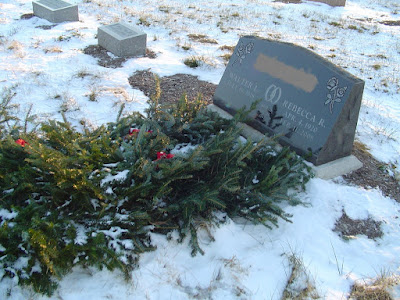
swan
I found it odd that I knew nothing of this particular "German" tradition. She and I share that heritage, and I do think it is sometimes a trial for our Irishman to deal with all the Teutonic energy that flows around our household. Still, I've been curious about where this "grave blanket" tradition comes from. Here's what I found:
Traditional grave blankets have been around for years, and are made from live pine branches, pine cones, baby's breath, and ribbons or bows. A grave blanket might have a centerpiece representing something special about a loved one -- a special occasion or hobby, a favorite pet or talent.
History tells us they were used to decorate grave sites in the winter, when flowers were not available or too fragile to withstand the bitter cold. Traditional grave blankets were used in the late fall and winter and were most popular during the Christmas season. They are designed for decorating the grave site for a short time and are then removed after the holidays. They are to the grave what the wreath is to the door. They are most commonly found in parts of the country where the winters are very cold and snowy -- especially in the midwestern parts of the U.S.
That, then, is the basic idea behind the lovely "grave blanket" that now adorns the grave of His mother...
swan
Subscribe to:
Posts (Atom)